
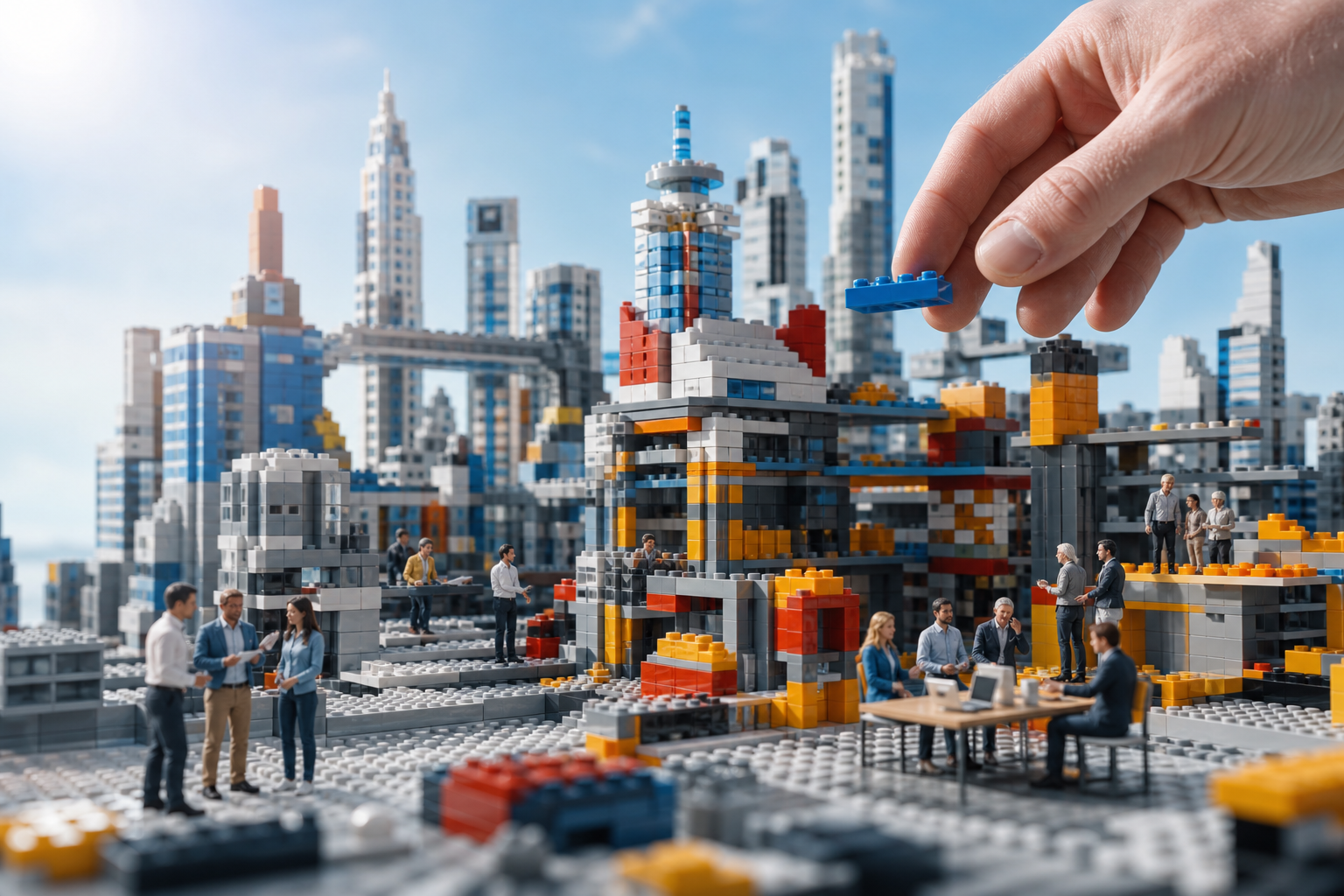
Lego® the next generation ERP, now closer than ever
The composable ERP story has always had a hole in it.
A common story is Modern ERP acting like the Lego® toy: it keeps a stable core and snaps on the capabilities needed as the business changes. Gartner has circled versions of this for more than a decade, first as Postmodern ERP and then as Composable ERP. And it works because every business wants technology that offers flexibility without chaos.
The problem is not ambition, but the metaphor. Lego® works because every toy brick made since 1958 connects seamlessly to any other Lego® brick. Different colors, different shapes, different purposes, but one standard connection structure underneath them all. Take that structure away and it’s no longer building a bigger, better model. It’s building a tower of parts that are bound to come crashing down to the floor.

Enterprise software has never had that standard. Every system carries its own data model, its own workflows and its own private understanding of basic business ideas. One system might define a customer by legal entity. Another might define the same customer by location, account structure or trading relationship. The same problem shows up with orders, suppliers, products, inventory and margin. The applications may all be doing their jobs, but the business still has to work out whether they are speaking the same language.
That is why best-of-breed software so often came with a bill that was larger than expected. The specialist capability looked attractive, and sometimes it was exactly what a team needed. But the integration work around it became expensive, laggard and hard to maintain. For years, composability was only realistic for organizations with the money, skills and patience to absorb that work. Everyone else was advised to keep a strong ERP core, extend selectively, and try not to create more complexity than the business is equipped to manage.
AI changes the economics, not the fundamentals
This is the point where AI genuinely changes the conversation. It is making it faster and cheaper to build capabilities, connect applications, create workflows and move information between systems. Some of the work that made Composable ERP difficult is becoming easier, and that matters. If the cost of integration falls, more businesses can start to think differently about how their ERP landscape should evolve.
But that does not mean the hard part disappears. AI can help move data, interpret patterns and generate outputs at a speed humans cannot match. What it cannot do is decide whether the data output reflects how the business works. If the same customer, order or margin figure means different things in different parts of the organization, AI does not fix the disagreement. It just gives the disagreement a faster route into decision-making.
That is why so many AI conversations eventually come back to data. Businesses are moving quickly because the opportunity is real, but data quality, integration complexity and the lack of the right skills to turn ambition into practical outcomes are still barriers. AI has not made the old ERP questions irrelevant; it has made them harder to ignore.
The value was never only in the model. It was always in the business context underneath it. Strip that context out and the output becomes thin. Feed AI inconsistent definitions and the output may look confident while carrying the same confusion the business already had.
The real constraint is shared understanding
Connecting systems was always the easier half of the problem. Apart from connection, the hardest parts of composable ERP were agreement on who owns the definition, who has the authority to change it, where the organization needs one version of the truth, versus where variation is acceptable because the work genuinely differs by function, market or operating model. The AI conversation needs to be more practical, beyond asking whether people will adopt it or if the tools are powerful enough.
The more useful question is whether the organization has created enough shared understanding for AI to produce answers people can trust. If the business has not agreed what its data means, it is asking technology to scale uncertainty.
That is also why ERP can no longer be thought of as just a system of record sitting behind the business. At its best, it provides a shared operating context across finance, operations, manufacturing and supply chain. It gives the organization a place where process, control and commercial reality meet, so intelligence has a stable working base.
What leaders should do differently now
Much of ERP strategy has focused on connecting systems. AI is making that easier than it has ever been. The challenge now is creating a shared understanding of the business across those systems, so the answers AI produces are grounded in reality rather than just data. A more composable architecture is not a license to keep adding applications until the landscape looks modern.
Before asking what to add next, leaders should be asking where the business needs more clarity. Which definitions are most important to decision-making? Where do finance, operations, supply chain and sales need a common view, and where should specialist systems extend the core without creating another layer of ambiguity? Who owns those definitions, and how are they maintained as the business changes?
That is where the Composable ERP conversation starts to get more interesting. AI makes the promise more realistic because it lowers some of the cost and effort that has historically held businesses back. But the organizations that benefit most will not be the ones with the biggest collection of connected tools. They will be the ones that use ERP to create a clear, trusted operating context, then build intelligence around it.
AI can help build bricks and connect them like Lego®. What it cannot do is settle the arguments businesses have about their own data. The organizations that get the most value from it will be the ones that can answer a much simpler question: When finance, operations and sales look at the same customer, are they seeing the same thing?
Disclosures:
Content within this feature has been adapted from source materials written on behalf of Sage. Referenced source materials and content appearing within The ERP Update are published under agreement with Sage and are provided solely for educational and informational purposes.
One or more trademarks or registered trade names of the Sage Group PLC (SGE.L) on the LSE, located in Newcastle upon Tyne in the United Kingdom, may appear within this content. Sage exists to knock down barriers so everyone can thrive, starting with the millions of small and mid-sized businesses they serve, along with our partners and our accountants. Customers trust our finance, HR, and payroll software to facilitate work and money. By digitizing business processes and relationships with customers, suppliers, employees, banks, and governments, their digital network connects SMBs, removing friction and delivering insights. Knocking down barriers also means they use their time, technology, and experience to tackle digital inequality, economic inequality, and climate crises.
Lego® is a registered trademark of The Lego Group, invented by Ole Kirk Christiansen and manufactured since 1948.
Any other trade names or entities mentioned within this article may refer to products registered, trademarked, or otherwise held by their respective owners. They are referenced solely for informational and educational purposes.
Graphic images, including the 'headline graphic' are AI creations of HubSpot AI.
This feature is "not" sponsored content. The article is provided for informational and educational purposes. The publication of this article does not represent an endorsement by either the editors or publishers, The ERP Update, or Insightful Accountant.
Note: Some registered Trademark ® symbols may have been eliminated from the articles within this publication for brevity due to their frequent occurrence. We attempt to credit such trademarked products within our respective article footnotes and disclosures.
Robert Sinfield, Senior Vice President, ERP, Sage
Robert Sinfield leads Sage’s enterprise resource planning strategy, guiding the evolution of ERP to meet the needs of complex, growing organisations. With over 20 years in enterprise technology, he brings deep expertise in product strategy, operational systems and global software leadership. He focuses on simplifying complexity at the core of the enterprise, embedding trusted intelligence into workflows and enabling organisations to unlock high performance. He is a strong advocate for modern, connected systems that give leaders clarity and confidence while respecting the operational realities businesses face every day.
Stay Updated on ERP & Business Software
Get the latest insights, comparisons, and resources delivered straight to your inbox.
Join the Conversation
Share your thoughts and comments on this article.